
Opening a practice is a series of small decisions, made over weeks and months, often while you’re still seeing patients and figuring it out in real time.
This guide was built from conversations with practitioners across North America who have opened their own clinics, made mistakes, and lived through it all to build a strong, sustainable business.
They’ll share their lived experiences: what worked, what surprised them, and what they wish they’d known earlier. They don’t skip the hard parts, but by the time you finish reading, you’ll have a clearer picture of what to expect along the way and how to move through it.
It might not be a perfect launch, but it will be a real one. And it will be yours.
If you've been thinking about opening a clinic, this guide is for you. Start reading, and then open that door.

OPEN
Making the Decision
to Open a Clinic
You trained to be a clinician. Now you're running a business.
If you're here, you've likely spent years building your clinical skills and thinking about what it would look like to do things your way. What doesn’t always get talked about is everything that comes with that decision: the location, the licensing, the buildout, the software, the marketing, the hiring, and the list goes on.
When you open a practice, your role expands with it. Alongside caring for patients, you're also managing finances, building systems, and making day-to-day business decisions. It’s a new layer of responsibility, and there’s a lot to navigate. The practitioners in this guide will tell you that honestly. But they’ll also tell you something just as important: there’s usually somewhere in your first or second year, where it starts to click. The systems work. Patients come back. You stop second-guessing every decision and start to feel more confident. You stop running a clinic and you start owning it.
The good news: it's learnable, and a solid grasp of the business side will help you show up at your best. Knowing what you're signing up for doesn't always make it easier, but it will mean fewer surprises along the way.
Are you ready to open a clinic?
The truth is, you may never feel ready.
Dr. Kellen Scantlebury started learning the business side of physical therapy while he was still in PT school. Joseph Ibe became a clinic owner because a job offer fell through just as his family was growing. Eric Vermander knew early on he wanted his own clinic, but still waited ten years before making the leap.
Different timelines. Different circumstances. But nearly every clinic owner we spoke with said the same thing: there was never a clear or obvious moment when uncertainty disappeared and everything aligned. What they did have was a combination of preparation, circumstance, and a feeling that it was time to move forward.
It’s less about certainty and more about recognizing when you’ve built enough foundation to be ready to get up and take the steps to open the doors.
Questions to ask before you take the leap
Are you prepared for the hours?
Running a business will typically stretch beyond the usual nine to five, especially in the beginning.
Do you have a financial cushion?
Most clinics don't turn a profit in the first months, but how much savings you need depends on how you’re starting. You may want to build gradually, seeing patients on evenings or weekends while maintaining other income. Or you might want to sign a lease and open full-time from day one.
Whatever your path, know your numbers (and your appetite for risk) before you dive in:
- What are your monthly expenses (personal and business)?
- What is your break-even point?
- If revenue comes in slower than expected, what’s your buffer?
Six months of savings to cover your personal and business costs is a common target for a full-time launch. A year gives you more breathing room and flexibility to build slowly.
The goal isn’t to hit a perfect number. It’s to get clarity before you commit.
Do you have a rough plan for your first 30 days before opening?
“Opening” can look different for everyone. You might sign a lease and launch full-time, or you might start part-time, virtually, or from a home office (where regulations allow). Whichever you choose, make sure the foundations are in place before you begin seeing patients: your space secured, your paperwork in order, your software chosen, your patient journey mapped, and at least one referral relationship started.
Do you know at least one person who's done this before that you can learn from?
A mentor, a coach, a former supervisor who opened their own place are great places to start.
Are you willing to do every job in the clinic before you hire for it?
Doing this will help you understand what you need when it does come time to hire.
Do you know who your patient is?
You don't need a full business plan, but having a sense of the community you’ll be serving will shape every decision you make.
OPEN
Planning Your Clinic
Step 1: Start with your space
Before you finalize a business name, design a logo, or choose your software, you need to find your space. Your location informs who your patients will be, your costs, your timeline, your required permits, and your buildout needs. You can’t build a financial plan until you understand what it will cost to operate in that space. And you won’t know your timeline until you know what that space requires.



Almost every clinic owner will tell you that the planning phase is longer than you expect. Not necessarily because you’re doing it wrong, but because there are often more moving parts than you can predict.
Here are a few steps that a lot of clinic owners only piece together after they learned the hard way. Read through it, use what’s helpful, and know that you’ll still make a few mistakes of your own. And that’s okay! Everyone does. That’s part of building something real.
Step 2: Licenses, permits, and insurance
The practitioners who move through this phase smoothly are the ones who build in extra time from the start. Healthcare permitting operates under its own regulatory rules, and timelines are often longer than landlords, contractors, and business owners expect.
Before you set an opening date, make sure you’ve worked through the following pieces and roughly in this order. Each step builds on the one before it, and skipping ahead can create problems that are harder to fix later. None of it is exciting, but getting it wrong (or doing it late) is one of the most common reasons new clinics end up having to push their opening date by weeks.
GROW
Your New Clinic Checklist
JANE
How Jane Supports Your New Practice
OPEN
Opening Day
SUSTAIN
Getting Your First Clients (and Keeping Them)
SUSTAIN
Marketing: There is No Universal Playbook
GROW
Building a Practice That Lasts
GROW
AI for New Clinic Owners
Getting your banking and business structure sorted isn't exactly the fun part, but it will save you a lot of stress down the road. The good news: most of these decisions are simpler than they feel at the start. Here’s what actually matters:
Step 3: Banking and billing model
Start with the basics
These decisions don’t require weeks of research, but they do require decisions and momentum.
| Open a business bank account
Keeping personal and business finances separate simplifies taxes, protects liability boundaries, and makes paying yourself clean and trackable.
| Prep your accounting
Hire an accountant or choose a simple accounting platform early and set up your chart of accounts before your first invoice goes out. It’s far easier to start organized than to reconstruct months of transactions later.
| Payroll and taxes
If you plan to hire, understand payroll obligations before your first employee starts. Even if you’re solo, confirm tax deadlines and estimated payment requirements. A short conversation with an accountant early on can prevent expensive mistakes.
| Get a payment processor
You’ll need a way to accept credit and debit cards. The rate differences are usually small, so don’t overthink it at the start. Choose a reliable processor, test it, and go from there.
How you get paid affects your cash flow, your admin load, and how patients access your services. Most clinic owners work within one of three common billing models, though variations and hybrids exist depending on your discipline, patient population, and business goals.
There isn’t a “right” model. Just make sure you understand what it means for your administrative workload and your cash flow before you choose, not after your first invoice goes unpaid.
Your billing model
Step 4: Design your physical space and your digital brand
Now the fun part! Once your space is secured, Meg and Neena, physiotherapists-turned-clinic designers at Articulate Design, recommend doing two things at the same time: develop your physical space and your digital brand at the same time.
Design them together, so the experience is cohesive from the first Google search to the moment someone walks through your door.

Step 5: The software decision that runs everything else
How will you book appointments and manage documentation? How will you bill? These decisions have implications for your space, your technology, and your time. Make them consciously, not by default.
The most common mistake new clinic owners make here is treating software as an afterthought. Your practice management software is going to run in the background of every single thing you do. It affects how patients book, how you chart, how you communicate with patients, and how you get paid. That’s why it’s important to research, try out, and choose your practice management software before you open, not after.
Step 6: Map your patient journey
Mapping the patient journey before you open helps you find the gaps while they're still easy to fix. Once patients are coming through the door, you're solving problems in real time, so set yourself up for success by doing this work now.
Before you open, map every interaction a patient has. Make sure you know how a patient gets from finding you online to walking through your door. The goal is to create a delightful and easy experience for them.
- How does someone find you? Google search, referral, social media, word of mouth? We’ll explore this further when we get into marketing.
- What do they see when they land on your website or Google listing? Is your address, phone number, and booking link current and visible?
- How do they book? Online, by phone, by email?
- What happens after they book? Do they receive a confirmation? Do they receive intake forms?
- How do they find your clinic on their first visit?
- What happens when they walk in? Who greets them? How long do they wait?
- What happens at the end of their first appointment? Is the next appointment booked before they leave? What happens if they don't rebook? Is there a follow-up system? For more on this, jump to Make rebooking a part of your practice.
Step 7: Define your clinic's identity
Who you serve shapes everything: the services you offer, the hours you keep, where you locate, how you communicate, even who you hire. This isn’t just a branding exercise. It's a clinical and operational one, and worth doing before you open.
| At its core, your clinic’s identity answers two questions: Who is this for? How do you want people to feel?
- Dr. Kellen Scantlebury: the active population in New York City, treated in a way that made them excited to come to PT instead of dreading it.
- Emily and Ghoncheh at Aphrodite Fertility: women navigating fertility, who need a space that is warm, feminine, and nervous-system-calming.
- Brandon Jacobs at Park Integrated Health: his hometown community in Sherwood Park, Alberta, who needed integrative care combining primary and allied health.
From this small set of examples, you can see that there’s really no correct answer for what your clinic identity should be. You just need to know what you are creating.
Across all of our conversations, clinic owners shared something interesting: the moment their practice stopped feeling “new” and started to feel established wasn’t tied to revenue or patient volume. It was when their clinic had a clear identity that truly resonated with the people they were serving.
| Who are you here to serve?
Be specific. "People in pain" is not specific enough. "Active adults in their 30s and 40s who want to avoid surgery" is.
| If your clinic were a person, how would they speak?
Are they warm and unhurried? Direct and efficient? That personality should live in your front desk, your social posts, and the way your space smells.
| How do you want patients to feel when they walk in?
| What problem do you solve that the clinic down the street doesn't?
| Five years from now, what kind of reputation do you want in this community?
Questions to help you define your clinic's identity

— Caroline, co-owner, Vitae Health
"We finally said, here we go, we're open. Let it happen. Okay. We're waiting. And it just... It takes time. Being patient that it will happen — if you really believe in what you're doing and have a passionate person on board, you just have to stay on that patient path."
Opening day is quieter than you think (and that’s okay)
Something almost no one tells you before you open: the first day is probably going to be quiet. Not because you've failed. Not because the market isn't there. Because building a patient base is a slow, real process that starts the day you open and compounds over months and years.
This is normal. The door being open is the beginning, not the payoff. What you do in the weeks and months after that door opens is what determines whether the practice thrives.
Do every job yourself, at first
Joseph Ibe recommends learning every aspect of running a clinic before hiring anyone, because it's genuinely hard to manage what you've never done yourself.
In practice, this means answering the phone. Sending confirmation emails. Entering patient records. Processing payments. Cleaning the treatment room. Doing the laundry. Writing the no-show policy. Figuring out why a billing claim got rejected.
It’s not glamorous. Sometimes it’s tedious. But doing it yourself first is how you learn what "good" looks like in each role before you try to hire for it. It's how you know what to document. It's how you catch the inefficiencies early, when they're cheap to fix. And it's how you earn the credibility to train someone else properly when the time comes.
When the loneliness sets in
Matt Lundquist at Tribeca Therapy in New York was direct about his experience launching a solo practice: "I found myself realizing that I would go many, many days where the only people I would have a conversation with from eight in the morning to seven at night were the doormen in my building and people who were paying me to have a conversation with them."
Dr. Kellen Scantlebury says it plainly: "It's really lonely being an entrepreneur. It's not like the Instagram and TikTok ads. That's a far cry from reality."
This is infrastructure, not self-indulgence. Build it before you need it.
"Find people at your level or slightly ahead who are willing to share, including the hard parts."
— Roxanne Francis, a psychotherapist and clinic owner in Ontario

| Find a mentor: Connect with someone who has opened a practice in your discipline and is willing to be honest about what it actually took.
Where to look: your professional college or association often has mentorship programs. So do discipline-specific networks like the Canadian Physiotherapy Association or the APA. If nothing formal exists, reach out directly to a clinic owner you respect. Most people are more willing to talk than you'd expect.
| Find a peer group: Meet up with other clinic owners at a similar stage. These relationships are priceless.
Where to look: Facebook groups and subreddits for your discipline are a good starting point (search "[your discipline] private practice" and you'll find active communities). Jane Community connects practitioners across specialties. Local business improvement associations often have small business owner groups that include clinic owners.
| Attend an event: Go to conferences, sign up for retreats, and look for industry gatherings for practitioners in your field.
Where to look: check out your professional association's website for conferences and events, search for discipline-specific continuing education events, or attend some of Jane's free webinars. These are all places where clinic owners at every stage show up and talk.
| Find professional support: A coach, a financial advisor, or a business consultant.
Where to look: Ask your accountant for a referral to a healthcare-focused financial advisor. For business coaching, Google searching “[your discipline] business coach" will surface options. Heard, for example, supports therapists with financial planning and tax prep.
How to find your support network

Remember: Nobody has it all figured out. Having a few people you can reach out to for advice, perspective, or just to say, “This is hard,” doesn’t just help you feel less alone. It makes you better at what you do.

Almost every new clinic owner wants to talk about marketing. Where do I advertise? What do I post? Should I run Google Ads? These are real questions, and they matter (and we'll get to them next), but before you spend a dollar on marketing, here's what actually made a difference for the clinic owners in this guide.
Give them something to talk about
Clinical excellence is not separate from your growth strategy. It is your growth strategy.
Dr. Kellen Scantlebury built four physical therapy clinics in New York City without a single investor dollar. He says he did it by giving people an experience so good they couldn’t stop talking about it. “It starts with exceptional care. You have to be good at what you do. The power of word of mouth referrals is everything.”
— Dr. Kellen Scantlebury, physical therapist and founder, Fit Club New York
”There are people currently on your schedule who are super-connectors. People who can connect you to 10 or 12 new patients. You don't need to know who they are in advance, you just need to serve everyone so well that the connectors in your community want to send people to you.”
Make rebooking a part of your practice
In your early days, the energy you put into rebooking the patients already in your care is worth more than anything you’ll spend on marketing.
Getting a new patient through the door costs real money. Every patient who walks out without a next appointment is a missed opportunity. Keeping the ones you already have? That's just showing up well.
Here's how to make rebooking a part of your practice:
- Come prepared to every session with a recommended plan of care. Of course the assumption is to always follow your professional training. Within that, patients want you to tell them to rebook if you think it’s helpful or necessary. They want you to be the expert and make the recommendations.
- Have the rebooking conversation as a clinical recommendation. "Based on what we've done today, I'd like to see you in X days to continue your treatment plan."
- Follow up with patients who don't rebook. Even a follow-up to the follow-up is all right. Sometimes practitioners get in their heads about not wanting to bother people. Dr. Kellen says, “Don’t be.” They want you to help them rebook.
- Identify and leverage your super-connectors.
Price your services with confidence
Health and wellness practitioners sometimes feel as though wanting to make money undermines their integrity as a caregiver. But the truth is, a practice that doesn't charge appropriately can't sustain itself, and a practice that can't sustain itself can't continue serving patients. Charging what you’re worth is not separate from caring about your patients, it is part of it.
Emma Jack, a physiotherapist and business coach, observes that practitioners who are nervous about their fees often over-explain them. They justify, apologize, or turn fees into a negotiation before the patient has even asked a question. This signals uncertainty to the patient, which is the last signal you want to send before a first appointment.

Be warm and be matter-of-fact. Your fees are what they are. You can answer questions, but you don't need to justify your worth with an explanation or a detailed breakdown of your overhead costs.
As a baseline, it's recommended to raise fees by 5-10% annually. This shouldn't be a dramatic jump, but a consistent increment that keeps pace with rising operational costs and reflects your growing expertise.
When you do raise fees, give patients notice, ideally six to eight weeks in advance, communicated clearly through your existing channels. Any pushback tends to resolve within a couple of weeks and is nearly always less intense than expected.
The practitioners who avoid raising fees because it feels uncomfortable or they're worried about patient reactions can find themselves years into a practice that can't grow, can't pay staff well, and can't invest in the training that would make them better. That is the real cost of avoiding the conversation.
Your opening rates aren't meant to last forever
Tips for setting your opening rates
| Do your research
What are practitioners in your discipline charging for sessions? Call a few clinics. Check websites. Talk to colleagues. Get a real range.
| Start in the middle
Place your rates at the mid-to-upper end of that range. Not at the top, but not at the bottom either. If you're newly in practice, it's reasonable to be a little below a practitioner with 20 years of experience. But don't discount yourself out of fear.
| Think about your overhead
Rent, software, insurance, supplies, your own salary. Work backward from what you actually need to earn to stay open and pay yourself reasonably. If your target fees don't cover that, something needs to change.
| Choose your billing model
If you're direct-billing insurance companies, your fees may be constrained by what they'll reimburse. If patients pay out of pocket and claim themselves, you have more control over what you charge.
When new clinic owners start thinking about marketing, they tend to hear the same kind of advice over and over: Run Facebook ads. Post on Instagram three times a week. Invest in SEO.
| The clinics that found traction in their marketing were the ones that understood their patients first, then chose the channel. Not the other way around.
It's tempting to treat marketing as a checklist of things you're supposed to be doing. But the clinic owners in this guide point to a different conclusion: there isn't one approach that just works. What works depends on who your patients are, how they find care, where they spend time, and what kind of trust they need before they book.
Put your energy (& money) where your patients are
If your patients are gathering somewhere, like a running group, a yoga studio, local gym, or a parent-teacher night, go. The highest-return marketing you can do is to show up in person.
Dr. Kellen Scantlebury tried Facebook ads in the early days of Fit Club New York. The leads were too low-quality and too time-consuming to follow up on. Money spent, not much to show for it.
What worked was showing up. His patients are athletes. They live at the gym, at the track, at marathons, and organized sporting events. They weren't going to find him scrolling Facebook at ten at night. He partnered with local influencers to host athlete-focused workouts and showed up at races and basketball courts. Face-to-face presence outperformed every channel he thought he was supposed to be using.
| Where do my ideal patients already spend time? In person, online, or both?
| Do they start their search with a Google query, a friend's referral, or walking by a clinic?
| What do they need to trust before they'll book? A reputation? A testimonial? An article that makes them feel understood?
| Is my practice better served by visibility (location, events) or credibility (reviews, writing, speaking)?
| What's one channel I could go deep on, rather than spreading thin across five?
Trust and credibility take time

First: Do you need a physical space at all?
This is something to think about when assessing who your patients are and the space you'll need. Some practitioners find they don’t actually need a clinic, especially if virtual care is an option. If your practice model allows for virtual sessions, a home office setup, or a shared/rented treatment room, that's a legitimate starting point.
Breakdown your budget
A rough startup budget for a small clinic typically runs between $30,000 and $150,000 USD, depending on your market, whether you're building out raw space, and how equipment-heavy your discipline is. That’s a wide range, which is why it’s so important to run your numbers before you start spending.
If you’re starting virtually or subleasing space, you’ll likely fall on the lower end. If you’re building out a branded physical clinic from scratch, expect to trend higher.
Here’s how to break it down:
| Lease and buildout: rent, deposits, renovations, signage
| Equipment: treatment tables, rehab tools, diagnostic equipment, furniture
| Technology: practice management software, computers, WiFi setup, payment processing
| Insurance and licensing: liability coverage, permits, regulatory fees
| Professional services: legal, accounting, branding, website
| Working capital: cash to cover expenses while revenue ramps up
It doesn’t have to be perfect
Start with what you can afford, then grow into the space you want. Joseph Ibe's first clinic had avocado-yellow walls and low lighting. "I grew out of it in a year," he says.
Location matters more than size
Find a space where your community already gathers. Also, good parking matters more than you think. If patients can't find you and get to you easily, that is a problem you will have to solve constantly.
If it’s hard to find, it will be hard to find
Be proactive about it. If your location is hard to find, have a plan to help patients find you. One idea: make a short video showing patients exactly how to get from the parking lot to the front door of the clinic. Simple, inexpensive, remarkably effective.
Professional registration
You can’t open a practice without it. Your regulatory body is the gatekeeper and every state (US) and province (Canada) has its own requirements, processing timelines, and documentation standards. What matters here isn’t memorizing every rule, it’s timing.
| What to do:
• Contact your regulatory body during your final year of training, not after graduation
• Confirm required documentation, supervision hours (if applicable), and processing timelines
• Ask how long approval typically takes once paperwork is submitted
• Don't assume your degree equals immediate independent practice rights
Some disciplines move quickly (Chiropractic, Physiotherapy). Others, like Psychology and Psychotherapy, require post-graduate supervised hours that can add 1.5 to 3 years after your degree before you reach full independent licensure.
TIP: Know your timeline before you set an opening date
Before you register for a Business License, you’ll need to decide on your legal structure. Whichever structure you choose will influence what you need to register, how you're taxed, the liability protection you’ll need, and how you pay yourself.
Your legal business structure
US
Most practitioners start with an LLC for liability protection without complexity
| LLC (Limited Liability Company)
A business structure that separates personal and business finances, protecting personal assets if the business is sued or carries debts.
Best for: Solo practitioners opening their first clinic who want liability protection without a lot of administrative overhead.
To consider: Less tax-efficient than an S-Corp at higher income levels.
| S-Corp
A tax election that passes business income directly to a personal tax return, reducing self-employment tax at higher income levels.
Best for: Practitioners generating strong revenue who want to reduce their tax burden with the help of an accountant.
To consider: Requires running owner payroll and more rigorous record keeping. Only worth the complexity once revenue is high enough.
Cash only
- Patients pay at the time of service
- Revenue comes in immediately
- Bookkeeping is simpler
- Patients submit their own insurance claims (if applicable)
Best for: Niche practices, faster cash flow, simpler admin.
To consider: Some patients may hesitate if they’re used to direct billing through insurance.
Hybrid model
- Accept insurance for some services or plans
- Offer cash-pay options for others
- Diversifies revenue streams
- Allows flexibility in pricing and positioning
Best for: Balancing patient accessibility with cash flow control.
To consider: Clear communication is critical. Without strong systems, billing complexity can increase and confuse patients.
Insurance-based
- You join insurance networks and bill on behalf of patients
- Easier patient acquisition in many markets
- Can make it easier for patients to access care
Best for: Disciplines where insurance coverage drives patient volume.
To consider: Reimbursements often take 60–90 days (sometimes longer). More admin and follow-up.
Other models
- Subscription / membership: Patients pay a recurring fee for access to a defined set of services. Provides predictable revenue but requires clear communication about what's included.
- Package-based: Patients purchase a bundle of sessions upfront. Encourages commitment to a course of care and improves cash flow.
- Sliding scale: Fees are adjusted based on a patient's ability to pay. Common in mental health and community-based practices. Expands access but requires clear policies to manage sustainably.
| Stage | What the patient experiences | Gaps to fix / notes |
|---|---|---|
1Discovery |
Finds clinic via Google, referral, social media, or word of mouth | |
2First impression |
Website, Google listing, or social profile; booking call or online booking | |
3Booking confirmation |
Email or text confirmation; intake forms sent and completed | |
4Finding the clinic |
Parking, signage, how to enter the building | |
5Arrival |
Greeted by whom? Wait time? Environment? | |
6First appointment |
Intake, assessment, treatment; care plan discussed? | |
7End of first appointment |
Next appointment booked before the patient leaves? | |
8Between visits |
Reminders, exercises, communication from the clinic? | |
9If no rebook |
Follow-up email or call within 7 days? | |
10Treatment complete |
Discharge plan? Maintenance schedule offered? |
Planning phase milestones
Questions to ask as you map your patient journey:
In roughly this order:
- Space found and lease signed
- Business license applied for
- Professional registration confirmed
- Buildout contractor chosen
- Business bank account open
- NPI / provider number obtained
- Insurance in place
- Practice management software chosen
- Patient journey mapped
- Website live with online booking
- Opening date set, after permitting is confirmed
Common mistakes to avoid (from clinic owners who already made them)
- Setting an opening date before permitting is confirmed
- Spending over two weeks choosing a bank or payment processor
- Designing the space before defining the brand
- Not understanding payroll tax obligations before opening
- Skipping the patient journey map
- Underestimating build costs
What to do when the phone isn't ringing yet
Eric at Vitae Health offers a helpful framing for the early days: "New practitioners need to be engaged in the community. It's not just sitting, twiddling your thumbs and waiting." The early period is an active phase. Here are some tips to get started:
| Get out of the building
Introduce yourself to neighboring businesses. Attend community events. Show up at places your potential patients already are. When people know you, they trust you, and that trust almost always converts to referrals.
| Connect with other practitioners in your area
Referral relationships are built over time through genuine connection, not a cold email. Meet the physiotherapist down the street. Introduce yourself to the GP in your building. These relationships will send you patients for years.
| Celebrate your opening
Invite the mayor for a ribbon cutting. Invite neighboring businesses to contribute to a raffle. Invite other health practitioners in the area. Get people genuinely excited that you're coming to the neighborhood. This is simple, inexpensive, and almost no one does it.
For finances, can I pay my:
- Personal and professional bills (and on time)?
- Taxes?
- Staff at their market value?
- Retirement fund?
For lifestyle, am I able to:
- Make time to refresh and recharge?
- Explore my hobbies and interests?
- Take time for self-care?
- Prioritize my family and friends?
- Evaluate expenses: Be honest about what you need to run your business effectively
- Set goals for growth: Where would you like to be in one year? Five?
- Conduct competitive research: Check on your local clinics and standard industry fees
- Craft a communication plan: Get your key messaging ready
- Prepare for questions: Lead with transparency
- Collaborate with staff: Communicate your plan clearly to your team to ensure a unified message
Ready to share the news? Great, here's a quick checklist to get started.
- Draft a client list of who you'd like to contact: past, present, future
Decide on the how:
- Website banners
- Booking reminders or notifications
- Clinic voicemail messages
- Printed signage in-office
- Newsletters or emails
- Social media
Checklist: How to raise your fees
Before you spend a dollar:
The problem wasn't the medium. It was timing. No one knew him yet so there was no trust, no familiarity, no reputation to build on. A broadcast campaign can't create credibility, it can only amplify credibility that already exists.
What did work was far simpler. David gave athletes exceptional care that helped them avoid surgery. Over time, he encouraged patients to share their experiences and outcomes in Google Reviews. Those real recovery stories showed prospective patients exactly what they could expect. He also spoke at team events and leaned into connections from his NFL career to strengthen his credibility within the athletic community.
For practices where the patient relationship is more intimate, like psychotherapy, trauma-informed care, or fertility support, trust becomes even more foundational. Patients often need to feel safe and understood before they ever reach out.
Matt Lundquist at Tribeca Therapy didn't run ads. He wrote blogs. Every weekend, for years, he sat in a coffee shop and wrote about therapy. Not content designed to game an algorithm, but writing that answered the real questions people hesitate to ask out loud. What does it mean to feel angry at your therapist? What if you worry you are too far gone to benefit from treatment? By the time readers found his website and decided to book, they already felt a sense of familiarity. The trust had begun long before the first appointment.
SEO and your website
For clinics where patients are making high-stakes decisions about surgery alternatives, fertility care, or mental health, reputation and word of mouth are the primary sales channel. In those early days, your job is to build that reputation, not advertise around it.
Dr. David Bruton opened Between the Lines Physical Therapy in Centennial, Colorado with advice he'd been given early: spend big on radio ads. So he did. $20,000 on radio campaigns, to be exact. The result was zero new patients.
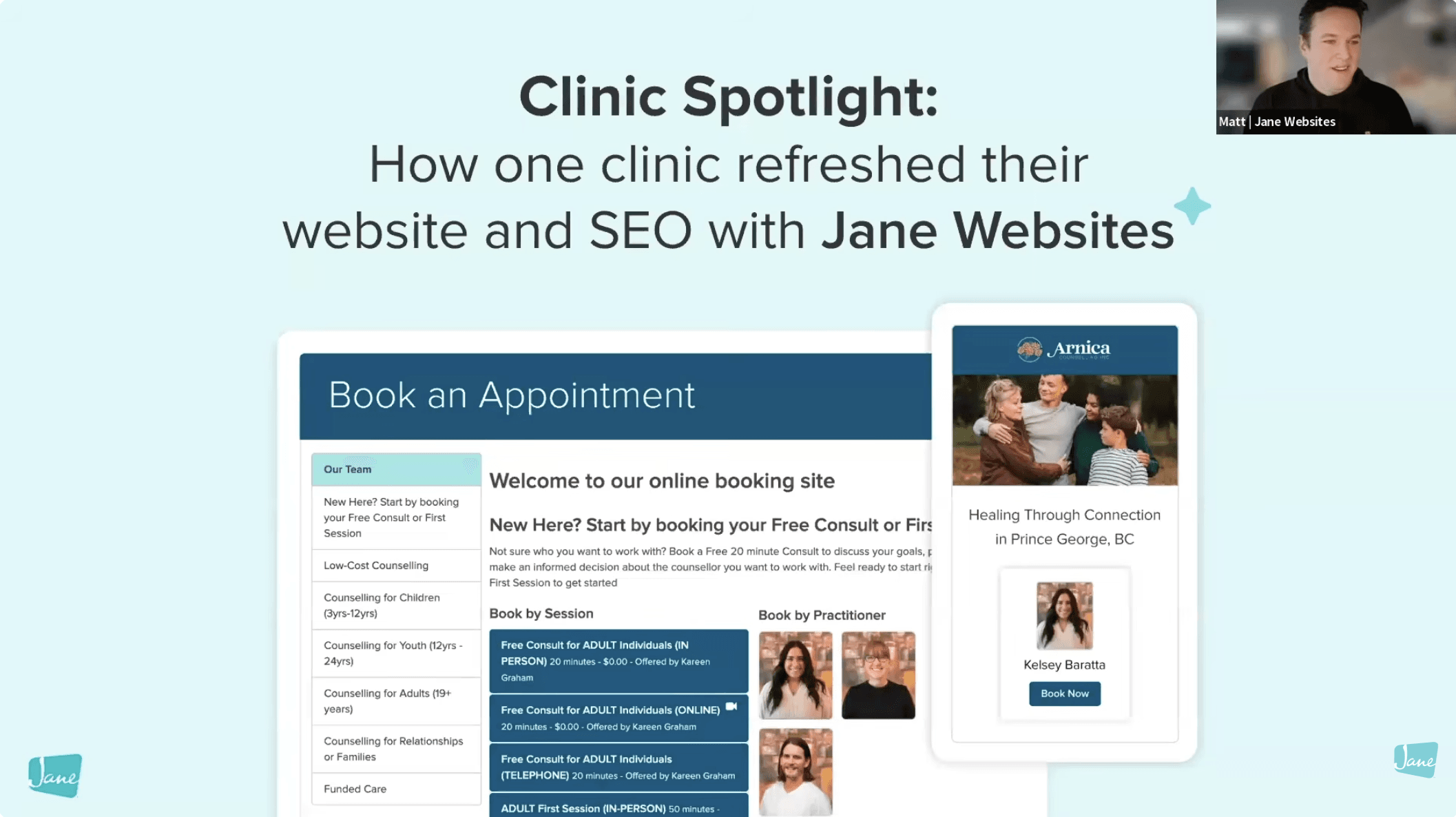
"From 2024 to 2025 it was a 55% increase. That was the year I made all the changes — my Google ranking, my Jane booking page, and my website. None of it would have been possible without working on all three."
— Tricia Wright, founder of Arnica Counselling, BC
Many future patients tend to start online, Googling symptoms, researching their condition, looking for answers they're embarrassed to ask in person, then your website is your most important marketing asset, and investing in making it genuinely helpful for those searches is likely worth it. This applies especially to specialty practices: fertility, mental health, paediatrics, chronic pain, sports performance.
Emily Marson and Ghoncheh Ayazi at Aphrodite Fertility Acupuncture in San Diego tried Yelp ads, Google ads, Instagram boosts for years. Some helped at the margins. Nothing moved the needle in a meaningful way.
When they hired an SEO specialist and reshaped their website to answer the exact questions their patients were already Googling, new patient numbers spiked. It wasn't about stuffing keywords into pages. It was about speaking directly to the problem their patients were living with.
They changed one of their main pages from "Pilates for women trying to conceive" to "Don't lose strength during pregnancy." That shift, from describing a service to naming a patient's actual fear, is what built trust.
Visibility: Your location can do the marketing for you
If you're choosing between a cheaper space that's harder to find and a more visible space with excellent foot traffic, run the numbers carefully. What you save on rent could mean more effort (and budget) spent on marketing. But what you spend on a more visible location might return ten times over in walk-in patients who wouldn't have found you otherwise.
Eric Vermander and Caroline King at Vitae Health and Sport in North Vancouver signed a lease in a ground-floor spot in an up-and-coming shopping center, with condos above, a high-end grocery store nearby, and a well-known coffee chain next door. The rent was steep, but they felt confident it would pay off. And it did. When they moved in, they didn't have to spend a dollar on advertising. People walking past on the way to the grocery store saw the clinic. People living in the condos above walked in. Foot traffic and visibility were built into the location itself.
They also negotiated a clause in their lease preventing any competing health or wellness clinic from opening in the same complex for ten years. That's not a small thing.

Social media: amplify what’s already true
Ask yourself, does my practice have something genuine and easy to share? If yes, show it. If not, invest first in creating it.
Austin Evans and Erin Joyce at Coast Mountain CrossFit use Instagram, and it works. Not because they hired a social media consultant or followed a posting schedule, but because their feed shows real people from their actual community doing real things: parents fitting in a workout before school pickup, retirees staying active, friends laughing through a tough set.
Social media amplifies what's already true about your clinic. It cannot create community that doesn't exist. For a CrossFit gym rooted in a neighborhood where members genuinely love each other, it's a natural extension. For a solo practitioner whose value is privacy and discretion, it might be irrelevant or even counterproductive.

| The owners who make it through year two aren't always the ones who had the best or easiest start. They're the ones who found the right people, built the right systems, and kept showing up.
A sustainable clinic isn’t built in year one. In that first year, you’re still learning the business as you run it, patching gaps as they appear, and doing what it takes to stay afloat. That is normal.
Year two will feel different. The adrenaline of opening fades and that go, go, go pace you set in year one isn’t sustainable. This is when the harder questions surface:
- Why isn’t the money adding up?
- Am I paying myself enough?
- Should I hire someone? Can I afford to?
- Is this the kind of clinic I actually want to run?
The shift from surviving to building
| The transition out of the "new clinic" phase isn’t triggered by hitting a revenue target or reaching a certain number of patients. It begins when you stop thinking about survival and start thinking about what kind of practice and culture you actually want to build. That shift from reactive to intentional is the real milestone. Here's where to start:
For many practitioners, it's not the clinical work that burns them out, it's the admin that follows them home. A clinic that depends entirely on its owner's memory and presence is not yet a business. The shift happens when your systems can run without your constant oversight. One of the most valuable things you can do for your clinic and your new employees is to have your systems organized and in one place.
Get organized and build systems
"Please systemize before you hire. Otherwise, you're not a CEO you're a CQA: Chief Question Answerer. Get everything out of your head. Put it in a Google Drive, build your SOPs, and then train people. Train them well and they won't come to you."
— Nicole McCance, psychotherapist and group practice builder
SEO isn’t just about keywords, it’s about clarity.
Your website doesn’t need to be flashy. It needs to be helpful.
If you’re not sure where to start, ask:
- What are my patients typing into Google before they find me?
- What questions feel too small or too personal to ask out loud?
- Does my website answer those directly, in plain language?
- Is booking obvious and frictionless once they’re ready?


Before you hire anyone, get the following systems in place, out of your head and organized into a document:
- How you onboard a new patient
- How you handle no-shows and cancellations
- How you bill insurance and process payments
- How you follow up with patients between visits
- How you handle patient complaints or feedback
- Every administrative task you do regularly, and how you do it
This isn't just for your future staff. It's for you, too. Writing it down is how you spot the inefficiencies, the gaps, and where you’ve been relying on instinct and might need a more defined process.
When to hire (and who to hire first)
The hiring question trips up a lot of clinic owners. They wait until they're at capacity, then hire in a rush without systems in place, and then wonder why training takes forever.
| Hire admin earlier than feels comfortable
As Nicole McCance puts it, "Those who hire an admin early in my program grow twice as fast. Because they've offloaded the minutiae, they've offloaded the overwhelm." The rough signal: if administrative tasks are regularly pulling you away from clinical hours, it's time. For most solo practitioners running a full schedule, this happens somewhere between months six and twelve.
| Hire for fit, not just credentials
When you go to a coffee shop you like, you expect the same experience every time. Your patients feel the same. Nicole learned this the hard way: when she stepped away briefly and handed off to a therapist with a completely different approach, not one client stayed.
Your patients came for an experience, not just a service. The people you bring in should be able to deliver that same experience.
| Hire a second practitioner, but..
Only once you have these two things: a patient base that genuinely needs the capacity, and systems clear enough that someone new could follow them without asking you a question every hour. If either is missing, you'll end up creating more work for yourself, not less.
-
1Candidate Quality
Hire for both skill and people skills
Clinical ability matters — but communication and patient experience matter just as much.
-
2Due Diligence
Verify credentials carefully
Confirm active license, insurance, and regulatory standing.
-
3Culture Fit
Make sure they fit your clinic
Do they align with your treatment style and team culture?
-
4Assessment
Use practical evaluation
Do a working interview, case discussion, or documentation review.
-
5Transparency
Be clear about pay and expectations
Explain compensation, schedule, admin support, and growth opportunities upfront.
-
6Retention
Look for long-term potential
Ask about career goals and whether they want mentorship or independence.
-
7Onboarding
Support them after hiring
Have a clear onboarding plan and defined performance expectations.
-
8Pipeline
Build relationships before you're hiring
Connect with schools and associations so you're not scrambling later.
Making sense of the money
In year two or three of running her practice, Roxanne Francis found herself wondering where the money was going.
— Roxanne Francis, Psychotherapist, speaker, and clinic owner, Ontario
"I saw other clinic owners who were scaling and I was like, how are they doing this stuff? It just felt like the money was falling into a hole somewhere."
She worked with a financial strategist who helped her identify gaps and build a clear path to profitability. What they found wasn't complicated, but it was invisible to her: a billing lag she'd normalized, a software subscription she'd forgotten, a pricing structure that hadn't been revisited since year one. These were straightforward fixes, but she needed someone who knew what to look for.
If the money feels fuzzy heading into year two or three, a single appointment with a healthcare-focused accountant or financial advisor is worth the cost to find out why.
Build the conditions and the culture will follow
Culture is earned, and it doesn’t happen overnight. It grows slowly from the systems you put in place and the standards you hold. The practices that develop a genuine sense of culture aren't the ones that wrote a mission statement. They're the ones that were consistent: in how they treated patients, in what they expected from staff, in what they refused to compromise on.
5 financial questions to answer every year
Reviewing these questions just once every year will help you catch small issues before they turn into larger ones.
- Are your fees keeping pace with rising costs? A 5–10% annual adjustment is a baseline, not a ceiling.
- Is there a billing lag in your practice? Claims sitting unpaid? Invoices going out late?
- Are you paying yourself a consistent salary, or taking whatever's left?
- Do you have three to six months of operating costs in reserve?
- Is your accountant actually familiar with healthcare businesses, or are you their only clinic client?
Set the tone from day one
You can’t force or manufacture culture. But you can set the tone.
- Greet every patient the same way, no matter who is at the front desk
- Hold regular team check-ins to address frustrations, reinforce what’s working, and celebrate small wins.
- Hire slowly and let go of poor fits early
- Model the behavior you want to see in how you communicate, handle mistakes, and speak about patients when no one is watching
Culture forms around consistency. If you hold the standard, the people around you will rise to it.
— Dr. Manju Asdhir, chiropractor and clinic owner, Clinic Accelerator
"The mistake I made early on was I had zero culture integrated into the clinic. I was just trying to get to the next step... And so even though I had the mentorship and I had the career path and all this stuff, I thought like, what's going on? There's a piece of the puzzle missing. And what that really was, was culture."
You build the conditions through your hiring decisions, your patient experience, and your standards, and culture forms around them. The practitioners who get this right aren't usually thinking about culture as a strategy. They are simply consistent, month after month. Over time, your team and your patients will be describing your clinic in the same terms you’ve been modeling all along.

AI is a great tool, if you use it thoughtfully
AI tools are showing up in every corner of healthcare and small business life. For a new clinic owner managing clinical care, admin, marketing, and business decisions, AI can be a genuinely useful thinking partner and drafting assistant. This section covers both clinical documentation and the everyday uses clinic owners are actually getting mileage from.
Think of AI like a capable new hire: good at first drafts, but needs clear direction and should never be left unsupervised. You still make every decision. But you don't have to start everything from scratch.
When does it make sense to start using AI?
- For a brand-new clinic owner it probably makes sense to build your clinical documentation habits first so you understand what your notes need to contain, how you structure your assessments, and what your regulatory body requires. That foundation matters.
- Once those habits are in place and the administrative load starts to feel heavy, AI Scribe tools are worth exploring seriously.
- Start with a few test sessions using your own voice before using it with patients. Pay attention to how the tool handles your terminology, your specialty language, and any ambient noise in your space.
What AI can actually do for you
Here’s where new clinic owners are finding AI genuinely useful in the early months:
| Writing policies and forms
No-show policies, cancellation fee language, intake form copy, and informed consent language. AI produces a strong first draft in minutes. Tell it who you are, what you need, and any specifics (a 24-hour cancellation window, a $50 late cancellation fee), then adjust to sound like you. You can also keep these in an AI platform so you or staff can search for answers quickly without having to read entire documents.
| Website and marketing content
Useful when you're staring at a blank page. Give it context about who you are and who your patient is. Edit from there.
| SEO suggestions
Paste a page from your website into an AI tool and ask for improvements. It can surface keywords and identify where your content could speak more directly to what patients are actually searching.
| Brainstorming and problem-solving
When you're working solo and stuck on a decision, like how to price a new service or structure your schedule, AI can give you more angles to consider. It won't decide for you, but it helps.
AI Scribe: finish your notes in the office (not your kitchen table)
Of all the AI tools available to clinic owners, AI Scribes have the clearest and most immediate impact on daily workload. An AI Scribe lets you record a clinical session and produces a draft note based on what was discussed. You review it, edit it, and sign it. The tool doesn't make clinical decisions. It handles the first draft.
For new clinic owners already managing booking, billing, patient communications, and clinical care, charting tends to spill into evenings and weekends. Beyond time savings, practitioners who use AI Scribes describe two other benefits that matter: reduced cognitive fatigue at the end of the day, and being more present during sessions. When you're not mentally tracking what to write later, you can give more of your attention to the person in front of you.
"I'd finished my day with all my notes done. Driving home with energy, fully off the clock. That was when I knew the scribe was here to stay."
— Sean Overin, Physiotherapist, BC
What you need to know before you use any AI tool
AI tools come with real responsibilities in a healthcare context. These apply whether you're using AI to write your website or to document a session.
For clinical documentation
- Patient consent is required before you record or transcribe a session. Capture this in your intake forms and confirm verbally before each appointment. It should always be easy and judgment-free to decline.
- Review every note before signing it. AI Scribes produce a draft, not a final document. The practitioner is always responsible for accuracy. Read every note before you lock it.
- Consent is ongoing. If you change tools or start using AI in a new way, loop your patients back in. They consented to a specific use at a specific point in time.
For all AI tools
- Security and compliance. Look for tools built specifically for healthcare that comply with privacy regulations in your jurisdiction: HIPAA in the US, PIPEDA in Canada, GDPR in Europe. Ask vendors directly where data is stored, how long recordings are retained, and what happens to your data if you stop using the tool.
- Check with your regulatory body. Guidelines on AI use in healthcare are evolving. Know what applies to your discipline before you start.
- Make sure your clinic owns your data. Not the vendor. You should be able to export or delete it at any time.
How to talk to patients about AI
When introducing AI Scribe in their sessions, practitioners who have seen the most positive responses lead with what it does for the patient, not what it does for you.
When the focus is on accuracy, presence, and better documentation, patients understand the benefit. Most hesitation fades when people feel informed and respected, not managed.
- Explain what the tool captures and what it doesn't.
- Tell patients where the recording goes and when it's deleted.
- Make it clear they can say no at any time without affecting their care.
- Include AI consent directly in your intake forms. That way, patients see it as part of your standard process rather than a surprise at the start of a session.

When AI isn't the right fit
Sometimes a patient isn't ready to participate in a recording, and that's completely fine. The goal is that both you and your patient feel comfortable. Make it easy for them to decline, and don't let it disrupt the session.
TIP: Most AI Scribe tools offer a dictation option
After the appointment, you can speak your notes aloud in your own words and at your own pace, and the tool turns them into structured documentation. No live recording needed. Your oversight is always essential, so you’ll still need review, edit, and sign off on the notes.
Before You Sign a Lease
Before You Open Your Clinic
Your First 90 Days

How Jane supports your new practice
The clinic owners you've read about throughout this guide are practitioners who built their practices from scratch. They navigated the licensing, the hiring, the marketing, the slow early months, and the shift into year two and beyond. Their stories, their advice, and their hard-won lessons are what this guide is built from.
Many of them are Jane customers, and that's not a coincidence. Jane was built specifically for health and wellness practitioners who are doing exactly this kind of work.
Opening a practice is about building something real. Jane is built to support that work from day one, and to grow with you as your clinic evolves.
— Elana Sures, owner and Clinical Director of Open Space Counselling, Vancouver
"Jane is my admin superpower. It lets me just focus on being a therapist."
Built for the way new clinics actually work
Running a clinic means carrying the clinical work and the business work at the same time. For most new owners, the finances, the systems, the software, and the hiring are all figured out on the job, not in the classroom.
Instead of shifting between separate tools, tabs, and systems, Jane has your core workflows like booking, charting, billing, and payments connected and working together so you’re not piecing it all together after hours. Jane won’t turn you into a business expert, but it will make the business side of running your clinic feel manageable, so you can stay focused on the care that brought you here in the first place.
| Jane doesn’t give you more admin to manage or more features than you need. It's built to get the admin out of the way so you can focus on the work you actually trained for.
The features new clinics rely on
| Scheduling and Online Booking
Jane customers manage their calendar, their team, and even multiple locations, all within Jane. They set the rules for when and how patients can book, and the system applies them automatically. Before every appointment, patients get a reminder by email, SMS, or both.
How it helps: Patients arrive on time and the schedule stays full, without the back-and-forth.
| Documentation and AI Scribe
Once they build their charting templates, Jane customers can use them every session, filling in only what's specific to that patient. AI Scribe lets them record or upload their session notes and get a structured draft back to review, edit, and sign.
How it helps: Charting and notes are finished during the day, not after the last patient leaves.
| Award-winning Support from real humans
Any time Jane customers have a question about a feature, need help with a billing issue, or are getting set up for the first time, a real person is always on the other line, happy to help.
How it helps: Customers have unlimited access to support by phone, chat, and email on every plan.
— Elana Sures, owner and Clinical Director, Open Space Counselling, Vancouver
"I cannot live without the online booking. That is probably the biggest game changer. You don't have to pursue clients. You don't have to send reminders. It's done for you. I know that so many clients book sessions in the middle of the night. They want that appointment on their calendar and they want it now."
— Robin Valadares, physiotherapist and certified financial counselor, Financially Fulfilled Physio, Ontario
"AI Scribe is a must. It saved me a lot of time, especially with my complex cases, clients who will talk unless you prompt them to switch courses. It catches great details. And that's how you can really connect with them."
— Emma Jack, Physiotherapist and business coach, Press Play Physio, Ontario
"The support is just well, we know it's second to none. The number of times I have called in a high anxiety situation and the level of care and detail and understanding [is] so helpful. It surprises me every single time how good the support team is. And it should not surprise me anymore."
You’ve read how other practitioners built their clinics. Now see how Jane has helped them run their practice. Jane brings scheduling, documentation, billing, and patient communication together into one place, so you can stay focused on providing excellent care from day one.
| Opening a practice isn’t easy. But with the right systems, the right community, and the right support, you show up stronger, and the care you deliver gets reflected in every part of the patient experience. That's what a practice you love looks like. That's what you're building.
Canada
Most practitioners start as a sole proprietor and incorporate later.
| Sole proprietorship
The simplest structure. The business and its owner are legally the same entity. Income flows directly to a personal tax return and is taxed at personal rates. Inexpensive and easy to set up.
Best for: Practitioners just starting out who want to keep things simple and low-cost while building their business.
To consider: No separation between personal and business liability. Personal assets are exposed if the business is sued or carries debts.
| Incorporation
A separate legal entity distinct from its owner. The corporation files its own tax return at corporate rates, generally lower than personal rates, and personal assets are protected from business liability.
Best for: Practitioners with growing revenue who want tax advantages and liability protection, and have the professional support to manage the additional requirements.
To consider: More expensive and complex to set up and maintain. Requires ongoing filings, corporate tax returns, and typically professional accounting and legal support.
Business license and registration
TIP: Don't put this off. The clinic owners we spoke with were consistent on this point: early professional advice saves money and headaches later. Get advice early, make the call, and move ahead. Keep the momentum!
Many new owners assume that registering a business name or incorporating means they're cleared to open. It doesn't.
Licensing is layered, and the layers don't talk to each other. You'll need to pursue each of the following separately: federal or state/provincial registration, a municipal business license, and zoning approval.
US
- Apply for your federal EIN from the IRS and your NPI from the NPPES registry as soon as your business entity is formed
- NPI numbers can take two to four weeks to process and you cannot submit insurance claims without one
- The municipal business license is the most commonly missed layer; most cities require it regardless of industry, including for home-based practices
- Verify zoning before you sign a lease. Discovering a zoning issue after signing is an expensive problem
Canada
- Register at the provincial level (or federally if incorporating nationally) and obtain a Business Number (BN) from the CRA
- You'll almost certainly also need a municipal business license. Start with your municipality, as they can usually point you toward what other levels require
- Obtain your provincial billing number early, it has a similar processing timeline to the US NPI
- GST/HST registration becomes mandatory once you exceed $30,000 in revenue across four consecutive quarters, so you’ll need to track this from day one
Quick reference: US & Canada registration terms

| On a mission to Help the Helpers
Jane is a practice management platform and EMR trusted by more than 260,000 allied health and wellness practitioners worldwide. Jane helps practitioners schedule appointments, chart treatments, bill insurers, and get paid all in one secure and connected platform.
Canada
- BN (Business Number) The Canadian equivalent of a federal business tax ID, issued by the Canada Revenue Agency (CRA). Used for taxes, payroll, and most government programs. This is the Canadian counterpart to the US EIN.
- NUANS (Newly Upgraded Automated Name Search) A required name search that confirms your proposed business name isn’t already in use, helping prevent registration delays or legal issues when incorporating.
- CRA (Canada Revenue Agency) The federal agency responsible for administering tax laws and collecting revenue in Canada.
- Provider / Billing Number Issued by a provincial health authority or regulatory college that allows a practitioner to bill the provincial public health insurance plan.
US
- EIN (Employer Identification Number) A federal tax ID number issued by the IRS that identifies a business entity for tax purposes. Required to open a business bank account, hire employees, and file taxes.
- IRS (Internal Revenue Service) The US federal agency responsible for tax collection and enforcement.
- NPI (National Provider Identifier) A unique 10-digit number that identifies a healthcare provider in the US. Required to submit insurance claims and bill Medicare or Medicaid. Issued by the NPPES.
- NPPES (National Plan and Provider Enumeration System) The federal registry where US healthcare providers apply for and manage their NPI numbers.
Insurance
Insurance isn't optional, and the type of policy matters more than the coverage amount (but that matters, too). You don’t need to become an insurance expert, but you do need to understand what you’re buying.
For both US and Canada, at minimum, you'll need:
- Professional liability coverage (malpractice)
- Commercial general liability coverage
You may also need:
- Coverage for supervised staff or students
- Tenant insurance if you're renting
US
Professional liability is typically required by state licensing boards and any insurance panel you want to bill through. Understand the difference between claims-made and occurrence policies before you buy, it has long-term implications if you ever close your practice or switch insurers.
Canada
Most regulatory colleges require proof of professional liability before they'll issue or renew your license. Check whether your professional association offers group coverage as it's often significantly cheaper than sourcing it independently. If you supervise students or interns, confirm your policy explicitly covers vicarious liability.
Clinical use permits
This one is separate from your business license and it surprises a lot of clinic owners.
| Healthcare occupancy often carries additional requirements:
A commercial space that is zoned for "office" use is not automatically approved for healthcare, which often falls under a distinct zoning or occupancy category with its own requirements around accessibility (wheelchair ramps, accessible washrooms), ventilation, plumbing, and in some cases dedicated treatment room dimensions or soundproofing standards.
- Accessibility standards (ramps, accessible washrooms)
- Ventilation and plumbing specifications
- Treatment room dimensions
- Soundproofing (especially relevant for mental health practices)
| Before you sign a lease:
Your landlord may not know whether the space qualifies, and has no legal obligation to find out on your behalf. Renovation surprises are expensive. Verification is not. - Contact your municipality directly and confirm the space's occupancy classification
- Ask whether the address permits use as a healthcare practice
- Ask whether inspections are required before you can open
- In some Canadian provinces, your regulatory college may also conduct its own facility inspection before issuing your practice permit
TIP: Plan for an additional four to six weeks (and in some cases up to 12) for permitting. Build this into your opening timeline from the start, not as a contingency.
— Joseph Ibe, Chiropractor and clinic owner in the Bay Area
"I probably spent two weeks deciding on a bank and a merchant service. Dude, choose a bank. They're all relatively the same."
— Nicole McCance, psychotherapist and business coach
"Do it scared. Ready is always in hindsight. You look back and say, okay, I was ready. It doesn't just show up."
— Caroline King, co-owner of Vitae Health in North Vancouver
"It's a puzzle. We had big checkboxes we knew were coming, but we couldn't do those until we got through certain things."
Opening a clinic is hard. Running one doesn't have to be.
That's where Jane comes in.


"I think Jane benefits both therapist and client and streamlines their relationship. I don’t need to constantly email availability; Jane handles reminders, paperwork, and payments. Jane’s efficiency shines in my operations. It’s been a complete delight. I can’t envision a better system for my practice."
— Rachel Fleischman, Psychologist and owner of Bliss Counselling, San Francisco
"As a passionate clinician and clinic owner, dealing with administrative and technical tasks is something I tend to avoid, which often leads to complications. The Jane team’s stellar customer service has always been so quick and kind. I’ve never hesitated to reach out for help when I needed it, which is in stark contrast to other companies I work with."
— Anniken Chadwick, Physiotherapist and founder of The Cheerful Pelvis, Vancouver
"Jane has to be the easiest, technologically friendly EMR on this planet. It is cloud-based, so I can access it from anywhere. It is professional, the look & feel is just beautiful. It is customizable, down to the colors for the booking website. Being in the aesthetic industry there are many EMR's to choose from but I would choose Jane over & over again. 10/10 recommend!!"
— Alessandra Zapata, owner of Zobia Health & Aesthetics, Florida


| The way your clinic looks and feels should reflect your brand. And your brand shouldn’t be finalized without understanding what the space will actually feel like in real life.
| The way your clinic looks and feels should reflect your brand. And your brand shouldn’t be finalized without understanding what the space will actually feel like in real life.


Use this template to trace every touchpoint in your patient's experience:

| The owners who make it through year two aren't always the ones who had the best or easiest start. They're the ones who found the right people, built the right systems, and kept showing up.
So, go open that door.


HOW TO START A PRIVATE PRACTICE
First Steps & Growth Advice from Experts Who Have Been There
Opening your first business is a big deal. This guide brings together real-world advice from clinic owners, practitioners, and industry experts across North America who have been where you are and learned along the way.

Created by Jane • jane.app
HOW TO START A PRIVATE PRACTICE
First Steps & Growth Advice from Experts Who Have Been There
Opening your first business is a big deal. This guide brings together real-world advice from clinic owners, practitioners, and industry experts across North America who have been where you are and learned along the way.
Created by Jane • jane.app
HOW TO START A PRIVATE PRACTICE
First Steps & Growth Advice from Experts Who Have Been There
Opening your first business is a big deal. This guide brings together real-world advice from clinic owners, practitioners, and industry experts across North America who have been where you are and learned along the way.
Created by Jane • jane.app
Opening a clinic can be hard. Running one doesn't have to be. That's where Jane comes in.
Jane brings your scheduling, charting, billing, and patient communication into one place, helping you get your admin done during the day, not after it. Fewer tabs, fewer logins, fewer things falling through the cracks.
The Jane Community connects you with clinic owners and practitioners at every stage: people who've opened a practice, survived year one, and are still showing up to help others do the same. Join a live event, browse discussions, or just lurk until you're ready to ask your first question. It's free to join, and you don't need to be a Jane customer.
Your schedule should support you, not slow you down.
With Jane, patients can book their own appointments and automated reminders will go out by email and SMS, reducing no-shows before they become problems. No back-and-forth. No double bookings. No last-minute scrambling. That means your day keeps moving, even when you're in session, at the end of a long day, or out of the office. The result is simple: fewer gaps, less follow-up, and a schedule that fills itself.
Turn Google searches into bookings with Jane Websites
For many new clinics, having online booking embedded directly into their website reduces drop-off dramatically. The easier it is to act, the more likely patients are to follow through.
If you're starting from scratch, Jane Websites builds your clinic's site in minutes, with SEO best practices already built in. Your services, practitioner profiles, and booking link stay current automatically through daily sync with your Jane account. No designer, no double entry, no setup stress.
Finish your notes before you leave the office with Jane's AI Scribe
Many practitioners we spoke to started their clinic expecting the clinical work to be the hard part. What catches them off guard is the charting that follows them home. Notes that should take minutes stretch into evenings because there simply wasn’t any time left in the day to write them.
Jane's AI Scribe is what practitioners reach for when that pattern needs to change. Record your session, get a structured draft back, and review, edit, and sign it before you walk out the door.